SS-31, elamipretide and MTP-131 are names for the same synthetic tetrapeptide used in laboratory work on mitochondrial membranes. They are not MOTS-c. A purity percentage on its own does not prove identity, activity or regulatory status. This guide separates the names, the cardiolipin literature, and the analytical records that actually travel with a research vial.
Contents
- SS-31, elamipretide and MTP-131
- SS-31 is not MOTS-c
- Cardiolipin context, and what is still uncertain
- What laboratory documents can confirm
- Claims, measurements and open questions
- Checks before you order a lot
- Research catalogue item and named medicine
- Questions
- Sources
SS-31, elamipretide and MTP-131
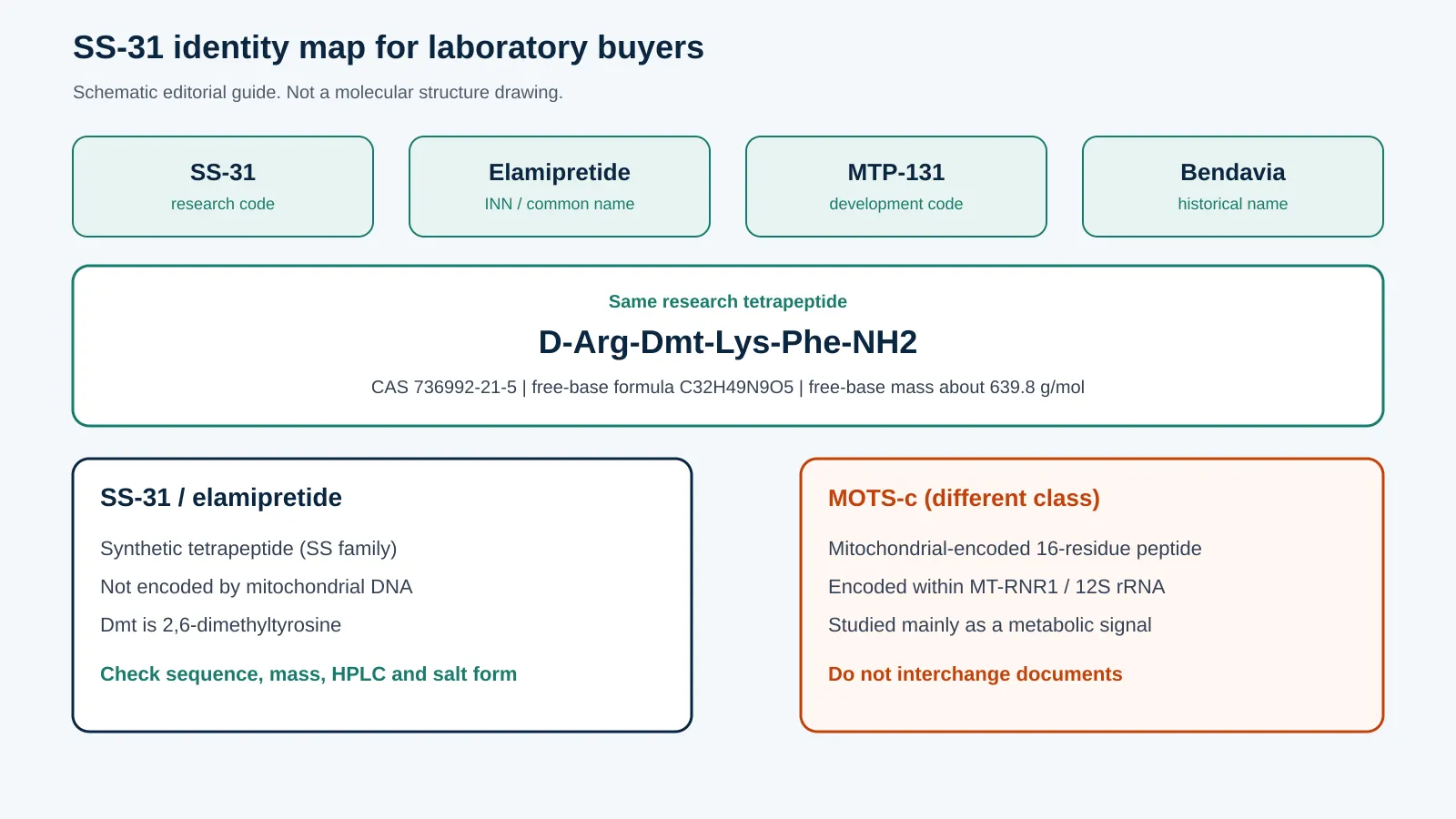
In research catalogues and in the peer-reviewed literature, SS-31, elamipretide and MTP-131 refer to the same amphipathic tetrapeptide from the Szeto-Schiller (SS) family. Older reports also use Bendavia. The sequence usually printed on research listings is:
D-Arg-Dmt-Lys-Phe-NH2
Dmt is 2,6-dimethyltyrosine. The NextCell catalogue pairs that sequence with CAS 736992-21-5, free-base formula C32H49N9O5, and a free-base mass near 639.8 g/mol. Those figures describe the peptide itself.
A certificate may also name a counter-ion, such as acetate, trifluoroacetate or chloride, and a salt stoichiometry. Liquid chromatography-mass spectrometry normally reports the mass-to-charge ratio of peptide ions. Compare that ion with the expected free-base peptide mass. Do not treat the peptide-ion mass as the formula weight of the whole salt, and do not treat it as a measurement of residual water or of how many milligrams of peptide are in the vial. Counter-ion identity, stoichiometry, water and peptide content are separate results.
A 2006 AAPS Journal article by Szeto reviews the SS peptides as cell-permeable, mitochondria-targeted peptide antioxidants and explains the aromatic-cationic motif associated with the inner mitochondrial membrane (PMID 16796378; open copy PMC3231562). That paper is a review, not a primary identity test for a commercial lot. Use it for the history of the SS class, not as a substitute for a certificate of analysis.
SS-31 is not MOTS-c
Both names appear in searches for mitochondrial peptides. They are not interchangeable.
| Point of comparison | SS-31 / elamipretide | MOTS-c |
|---|---|---|
| Origin | Synthetic designed tetrapeptide (SS family) | Mitochondrial-encoded peptide |
| Length | 4 residues, including non-coded Dmt | 16 residues |
| Genome link | Not encoded by mitochondrial DNA | Encoded within MT-RNR1 / 12S rRNA |
| Usual research framing | Inner-membrane and cardiolipin-linked tool peptide | Metabolic signalling |
| Records to keep separate | Sequence, peptide-ion mass, HPLC, salt form, lot number | Its own sequence, mass, HPLC and lot number |
If a protocol or purchase order says MOTS-c, do not substitute SS-31, or the reverse. The separate overview of MOTS-c is about that other molecule.
Cardiolipin context, and what is still uncertain
Cardiolipin is an anionic phospholipid concentrated in the inner mitochondrial membrane. In that setting it helps organise cristae and supports respiratory-chain components. SS-31 entered the literature as a peptide studied in that cardiolipin-rich environment. Primary papers support interaction hypotheses, with clear limits.
Birk and colleagues, 2013 (Journal of the American Society of Nephrology). They used a polarity-sensitive fluorescent analog of SS-31 to study binding to cardiolipin, and they reported protection of mitochondrial cristae membranes in a renal ischaemia model (PMID 23813215; PMC3736700). The fluorescent analog supports a binding model. It is not the same chemical as every unmodified research vial.
Mitchell and colleagues, 2020 (Journal of Biological Chemistry). They studied SS-31 with model and mitochondrial membranes and reported interfacial partitioning, changes in lipid packing and changes in surface electrostatics (PMID 32273339; PMC7247319). That is biophysical work on membranes. It is not a release test for a supplier lot.
Chavez and colleagues, 2020 (PNAS). They mapped protein interactions with an N-terminal biotinylated SS-31 analog (bSS-31) in isolated mitochondria from aged mouse heart (PMID 32554501; PMC7334473; PNAS). Do not read a biotinylated-analog interaction map as if it were an analysis of an unmodified catalogue vial.
Tung and colleagues, 2025 (International Journal of Molecular Sciences). This is a secondary review of structure, proposed mechanisms and development history (MDPI). Cite it as a review, not as primary evidence for a vial.
Localisation at the inner membrane, and effects linked to cardiolipin, are research hypotheses supported by published studies. An HPLC percentage, a peptide-ion mass, or a research-use-only label on a catalogue page does not demonstrate those effects. An assay still needs a stated model, controls, and a clear record of whether the experiment is testing the peptide, the membrane, or both.
What laboratory documents can confirm
For a research peptide, three questions are easy to collapse into one number, and they should stay separate:
- Is the material consistent with the named peptide? Identity support, often from peptide-ion mass.
- How clean is the main detected component under a stated method? Purity, often from HPLC area percent.
- What is still unknown for the experiment? Activity, stereochemistry, salt stoichiometry, water, peptide content and regulatory status.
Longer notes on peptide identity versus purity, HPLC versus LC-MS and how to read a certificate of analysis cover the general method logic. The same limits apply to SS-31 as to any other short synthetic peptide.
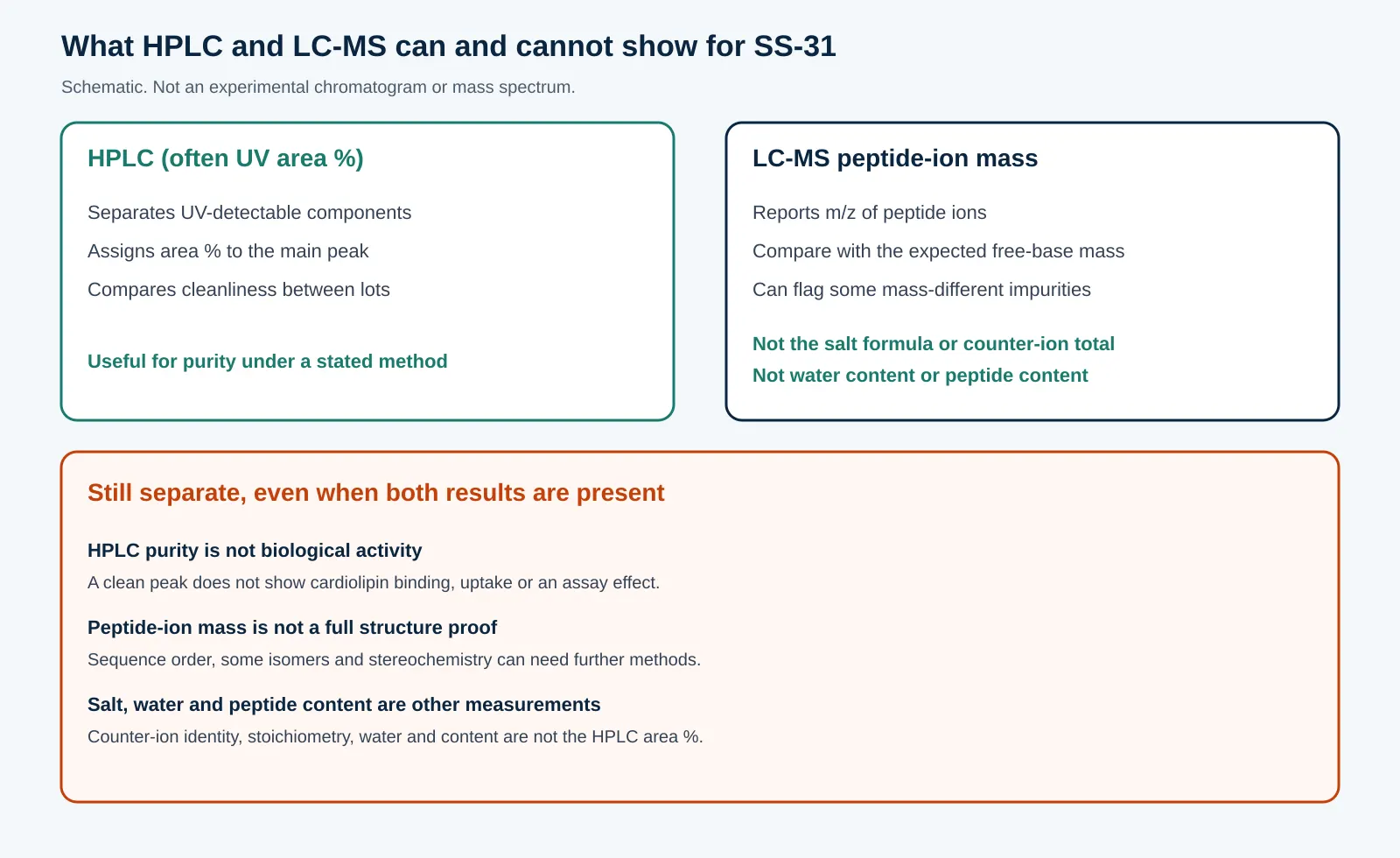
Identity and peptide-ion mass. Mass spectrometry, often as LC-MS, can show that an observed m/z fits the expected free-base mass of SS-31. That is useful support that the main detected species is consistent with the intended peptide mass. It does not, by itself, prove sequence order, every stereochemical assignment, or the salt. Closely related isomers can need MS/MS, comparison with known reference materials, or a chiral method.
HPLC purity. An area-percent result says how much of the UV response sits under the main peak under defined conditions. It helps compare related-substance levels between lots. It does not prove biological activity, cardiolipin binding, mitochondrial uptake or assay performance. Co-elution, wavelength, integration and sample preparation all affect the number.
Salt form, water and peptide content. Lyophilised peptides are often supplied as salts. HPLC area percent is not the same as peptide content, residual water or free-base equivalence. If a certificate states acetate, trifluoroacetate or chloride, read that line as its own result. Do not force the free-base mass of about 639.8 g/mol to stand in for the salt, the water or the content.
Lot documents. A useful certificate is tied to a lot: product name, lot number matching the vial, method statements, reported results, and a test or release date. A generic template that cannot be tied to the vial is weak evidence. The SS-31 10 mg listing refers to batch identification and laboratory documentation. Check that the document you read matches the lot you receive. This article does not claim that a particular live batch PDF was opened.
Research-use-only wording. That wording describes the intended use of the catalogue item. It is not a medicinal authorisation, and it is not permission for every laboratory purpose an institution might consider.
Claims, measurements and open questions
| Statement you may see | What is usually measured | What can remain open |
|---|---|---|
| At least 99% purity | HPLC main-peak area percent under a stated method | Co-elution, method detail, and whether a chromatogram is provided |
| Identity confirmed | Observed peptide-ion mass consistent with the expected free base | Stereochemistry, some isomers, and salt form |
| Salt or counter-ion stated | Identity and stoichiometry on the certificate | This is not the same number as the peptide-ion mass |
| Batch certificate available | Lot-linked methods and results | A generic certificate without the vial lot number |
| Research use only | Intended-use statement | Not medicinal-product status or local approval |
| Mitochondria or cardiolipin context | Published studies, sometimes on analogs | Not shown by HPLC or mass of the purchased vial |
Checks before you order a lot
- Confirm the names on the label match the protocol: SS-31, elamipretide or MTP-131, and that the material is not MOTS-c.
- Check sequence, CAS, free-base formula and free-base mass against the lot document, then read any stated salt on its own line.
- Look for identity support, usually peptide-ion mass, and purity, usually HPLC, as separate results.
- Prefer a certificate whose lot number matches the vial.
- Read the method before treating a purity percentage as decisive. See identity versus purity and HPLC versus LC-MS.
- Do not treat HPLC purity as proof of activity, peptide-ion mass as a complete structure proof, or research-use-only wording as regulatory clearance.
- Keep cardiolipin, inner-membrane and analog-cross-link papers in the published-studies column until the model you are using shows a readout.
Research catalogue item and named medicine
Elamipretide is the international nonproprietary name associated with SS-31. In the United States, the FDA granted accelerated approval on 19 September 2025 to Forzinity (elamipretide) injection to improve muscle strength in adult and paediatric patients with Barth syndrome weighing at least 30 kg (FDA announcement; NDA 215244). That decision concerns a specific medicine, indication, dosage form and quality system in the United States.
A lyophilised research-catalogue SS-31 listing is a different supply from that named medicine. Shared nomenclature does not make a research vial interchangeable with Forzinity. It does not copy clinical labelling onto a research listing. It does not authorise human use of research material, and it does not mean the catalogue item holds a European Union marketing authorisation. Laboratory buyers should handle research peptides under their institution's rules. A named medicine is a separate regulatory object.
This article does not give doses, treatment instructions, self-administration advice or clinical outcome claims for research materials.
Questions
Is SS-31 the same as elamipretide and MTP-131? Yes. In research and literature usage those names refer to the same tetrapeptide. Bendavia appears in older reports.
Is SS-31 the same as MOTS-c? No. MOTS-c is a mitochondrial-encoded 16-amino-acid peptide with a different origin. See the MOTS-c overview.
Does HPLC purity prove that SS-31 will be active in an assay? No. HPLC reports chromatographic cleanliness under a method. Activity and membrane interaction need their own experiments.
Does a matching mass prove complete identity? A peptide-ion mass consistent with the free base is supporting evidence, not a complete structural proof. Stereochemistry and some related impurities can remain open.
Must LC-MS match the salt formula? No. The spectrum typically shows peptide-ion masses. Salt identity, stoichiometry, water and peptide content are separate from that ion mass.
Does research use only mean the material is authorised as a medicine? No. The phrase states intended research supply. It is not a medicinal authorisation in the European Union or elsewhere, and it does not make the vial the same product as Forzinity.
Sources
- Szeto HH. Cell-permeable, mitochondrial-targeted, peptide antioxidants. AAPS J. 2006;8(2):E277-E283. PMID 16796378. PMC3231562. Review.
- Birk AV, Liu S, Soong Y, et al. The mitochondrial-targeted compound SS-31 re-energizes ischemic mitochondria by interacting with cardiolipin. J Am Soc Nephrol. 2013;24(8):1250-1261. PMID 23813215. PMC3736700. Primary paper; binding work used a fluorescent analog.
- Mitchell W, Ng EA, Tamucci JD, et al. The mitochondria-targeted peptide SS-31 binds lipid bilayers and modulates surface electrostatics as a key component of its mechanism of action. J Biol Chem. 2020;295(21):7452-7469. PMID 32273339. PMC7247319. Primary paper.
- Chavez JD, Tang X, Campbell MD, et al. Mitochondrial protein interaction landscape of SS-31. Proc Natl Acad Sci U S A. 2020;117(26):15363-15373. PMID 32554501. PMC7334473. PNAS. Primary paper using biotinylated analog bSS-31.
- Tung C, Varzideh F, Farroni E, et al. Elamipretide: a review of its structure, mechanism of action, and therapeutic potential. Int J Mol Sci. 2025;26(3):944. MDPI. Secondary review.
- U.S. Food and Drug Administration. FDA grants accelerated approval to first treatment for Barth syndrome (Forzinity / elamipretide). 19 September 2025. FDA announcement.
Related pages: SS-31 10 mg specifications, certificate of analysis, identity versus purity, and HPLC versus LC-MS.
Research use only. Materials discussed here are supplied for laboratory research and analytical work. They are not intended for human or veterinary use, self-administration, diagnosis, treatment or prevention of disease. Sharing a nonproprietary name with a medicine does not make a research vial that medicine.
Research Use Only: All peptides discussed in this article are intended for laboratory research purposes only. They are not approved for human consumption, medical use, or therapeutic applications.